
AI in Nurse Scheduling: What’s Hype and What’s Actually Working
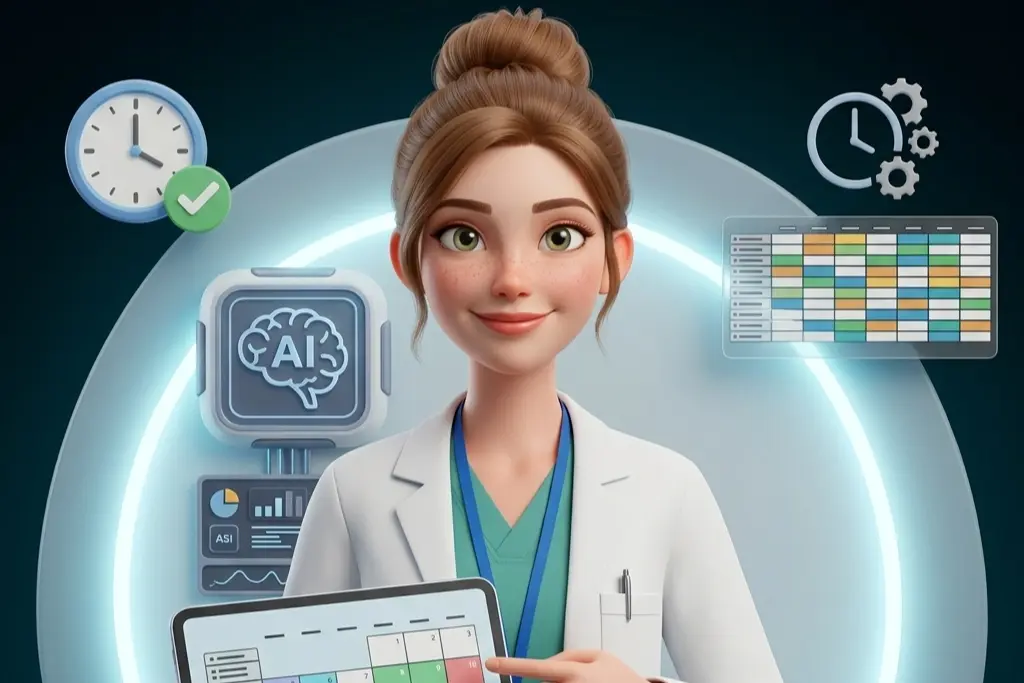
If you’ve attended a healthcare staffing conference recently, opened a trade publication, or simply scrolled through LinkedIn, you’ve seen the headlines: AI is going to revolutionize nurse scheduling. Platforms promise to eliminate staffing gaps, predict call-offs before they happen, and create perfectly optimized rosters that balance patient acuity with nurse well-being.
Some of that is real. Some of it is marketing. And as a nurse or facility administrator, you deserve to know the difference.
Here’s an honest breakdown of where AI in nurse scheduling is genuinely delivering, where it’s still falling short, and what it means for the future of the profession.
What AI Scheduling Tools Actually Do
Let’s start with the mechanics, because the term “AI” gets applied loosely to everything from a basic automated reminder to a sophisticated machine-learning model.
In the context of nurse scheduling, AI-powered tools typically operate in a few key ways:
Predictive analytics for demand forecasting. Using historical census data, seasonal patterns, and real-time inputs, these systems can predict when a unit is likely to be understaffed before it happens. Rather than a charge nurse scrambling to fill holes at 5 AM, the system flags a potential gap three days in advance and prompts action.
Preference-aware scheduling. Modern platforms can ingest nurse preferences — shift types, day/night preference, days off requests — and try to balance individual needs against coverage requirements. This goes beyond what any manual scheduler can reasonably track across a large staff.
Real-time acuity matching. Some systems pull in patient acuity data and cross-reference it with who’s scheduled, flagging when a unit may be inadequately staffed relative to patient complexity rather than just headcount.
Open shift management. For PRN and per diem workers specifically, AI-powered platforms including on-demand staffing apps can match open shifts with available qualified clinicians, reducing the time it takes to fill last-minute gaps from hours to minutes.
Where It’s Actually Working
The results from early adopters suggest meaningful, if uneven, progress.
Health systems using AI-assisted scheduling tools have reported reductions in overtime costs, fewer last-minute agency calls, and modest improvements in schedule equity — meaning nurses feel their preferences are being considered rather than ignored. Cleveland Clinic has implemented tools that give nurse managers a campus-wide view of staffing projections shift by shift, week by week, enabling proactive decisions rather than reactive scrambling.
On the documentation side — which directly affects nurse workload and burnout — AI transcription tools have shown measurable impact. AI-assisted transcription has been shown to reduce note-taking time by roughly 20% and cut after-hours documentation work by around 30% in a Duke University study. Mass General Brigham observed a significant reduction in physician burnout within weeks of deploying AI scribes, results that are being tracked for nursing staff as well.
In July 2025, Symplr acquired Smart Square scheduling software from AMN Healthcare, integrating AI-driven scheduling with predictive analytics and real-time staffing management — a sign that major healthcare technology companies are treating this space as mature and worth consolidating, not just experimenting with.
Epic Systems is also rolling out AI-powered clinical documentation tools designed to automatically draft portions of patient records, aiming to free up meaningful blocks of time that nurses currently spend on administrative tasks.
Where the Hype Outpaces the Reality
Here’s what the vendor pitch decks often leave out:
AI scheduling is only as good as its data. If a facility’s historical census data is incomplete, if staff preferences aren’t systematically entered, or if the system isn’t integrated with the EHR, the outputs will be poor. Garbage in, garbage out — and in healthcare, bad staffing decisions have real consequences.
Adoption and trust are significant hurdles. Many nurses and schedulers are skeptical of algorithmic scheduling, and for understandable reasons. If a system’s “optimized” schedule routinely conflicts with personal commitments or seems to ignore preferences that were clearly entered, staff will stop trusting it. Technology that isn’t trusted isn’t used.
Predictive models struggle with the truly unpredictable. AI can forecast seasonal flu surge demand based on historical patterns. It cannot predict a mass casualty event, an unexpected outbreak, or a significant portion of staff calling in sick on the same day. The edge cases where staffing crises are most acute are precisely the situations where algorithmic tools are least equipped to help.
The nursing shortage isn’t a scheduling problem. This is perhaps the most important caveat. No AI system can schedule nurses who don’t exist. The U.S. faces a projected shortfall of tens of thousands of registered nurses in the coming years, and AI optimization tools don’t address the structural causes: wage suppression, burnout, inadequate pipeline, and poor working conditions. A smarter schedule doesn’t compensate for a unit that’s chronically understaffed.
What It Means for Nurses
For working nurses, the practical implications are cautiously optimistic. The best implementations of AI scheduling should mean more schedule transparency, faster response when you pick up or drop a shift, and a greater likelihood that your stated preferences are reflected in what you’re actually assigned.
For PRN nurses especially, AI-powered on-demand platforms represent a genuine improvement over the old call-list model. The ability to see open shifts in real time, match based on credentials and location, and confirm in seconds rather than playing phone tag is a material quality-of-life improvement.
The risk to watch is algorithmic opacity — being told what your schedule is without any clear sense of how or why it was generated, and having no recourse when it’s wrong. Nurses should advocate for scheduling tools that explain their logic, allow for easy corrections, and incorporate nurse feedback into future iterations.
What It Means for Facilities
For administrators, the ROI case for AI scheduling tools is real but conditional. The facilities seeing the strongest results are those that invested in data quality before deploying these tools, trained staff thoroughly on how to use them, and treated the technology as a support to human schedulers rather than a replacement.
Tools that reduce time spent on manual scheduling, decrease overtime costs, and improve shift fill rates represent genuine operational gains. But the facilities that see those gains are the ones that did the implementation work, not the ones that bought a platform and expected it to run itself.
The Bottom Line
AI in nurse scheduling is neither the revolution the vendor decks promise nor the irrelevant gimmick that skeptics dismiss. It’s a maturing set of tools that, deployed thoughtfully, can reduce friction in a genuinely difficult operational problem.
The honest summary: predictive analytics and preference-aware scheduling are working. Real-time open shift matching is working. Documentation AI is showing early promise. Claims that AI will solve the nursing shortage or eliminate the need for human judgment in staffing decisions are not working — because they were never true to begin with.
Use the tools. Question the hype. Keep humans in the loop.